
The Midway
Royal Tunbridge Wells
Kent
CONTRACT COMPLETION DATE 3 October 2025
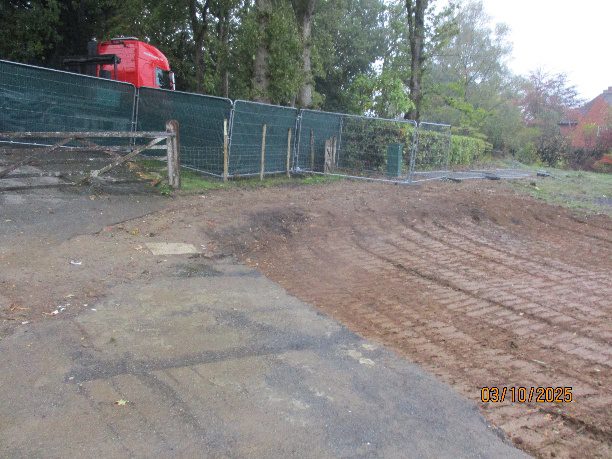
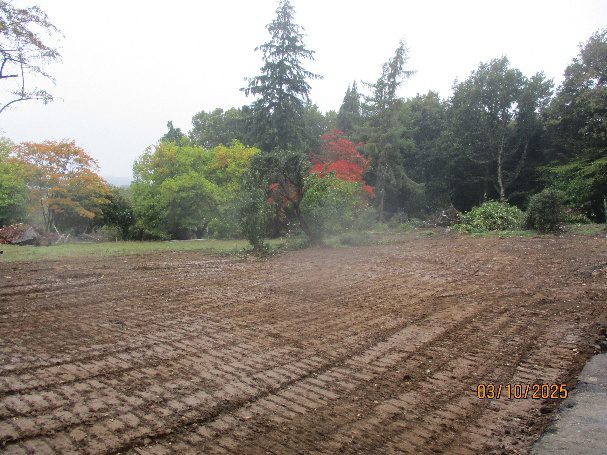
Demolition of Mulberry House (Formerly Badgers Holt), The Midway, Royal Tunbridge Wells, Kent
Project Overview
Dorton Demolition & Excavation Ltd (DDE) was appointed by The Park Lane Group to undertake the demolition of Mulberry House, a dilapidated two-storey dwelling and associated outbuildings, to facilitate the construction of a replacement dwelling, garage and upgraded access arrangements.
Although modest in scale, the project presented significant ecological and operational challenges. The site was bordered by mature woodland, hedgerows and environmentally sensitive habitats supporting protected species, requiring the demolition works to be planned and executed with exceptional care. DDE successfully delivered the project within a demanding three-week programme while achieving full compliance with all ecological, planning and arboricultural requirements.
Views of the residential dwelling with flat roof extensions.
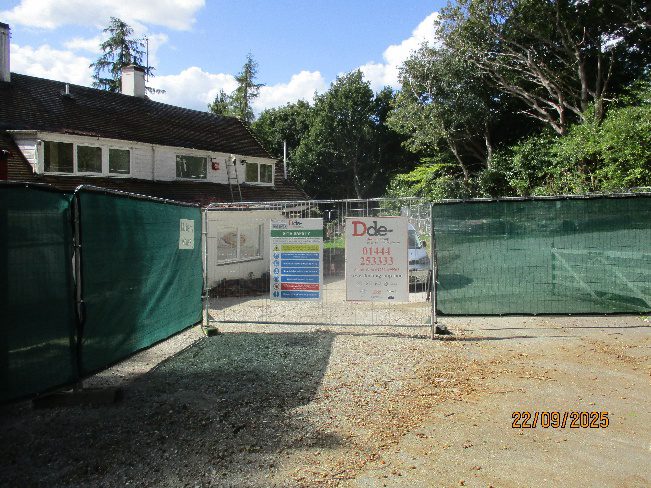
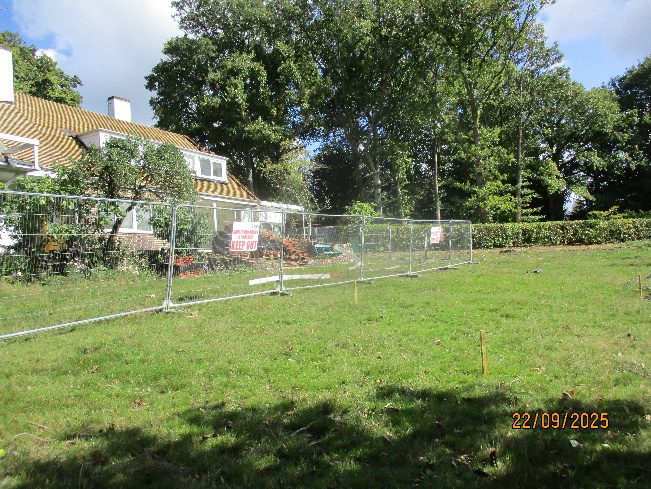
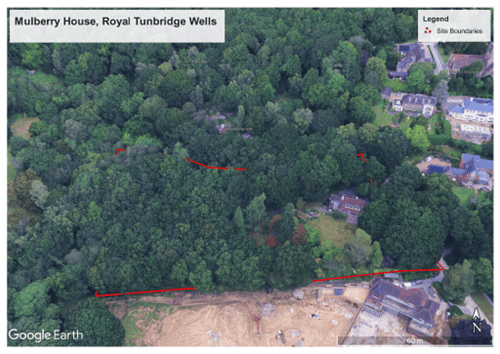
Deciduous woodland dominates the site.
The Challenge
Operating Within a Highly Sensitive Ecological Environment
The project’s defining challenge was the need to deliver a time-critical demolition programme within an environmentally constrained site containing protected species and sensitive habitats.
Extensive woodland along the site’s boundaries provided important ecological corridors for wildlife, creating the potential for demolition activities to adversely affect protected habitats through dust, noise, vibration and pollution. Strict environmental controls were therefore required throughout the works to prevent disturbance and ensure compliance with planning and ecological obligations.
Protecting Protected Species
Ecological surveys identified an active bat roost within the south-west corner of the property. To facilitate the works, a Natural England bat licence was obtained, requiring a carefully controlled sequence of operations. Roof coverings, soffits and fascias were removed by hand under a separate contract before demolition commenced, ensuring full compliance with the licence requirements while maintaining programme certainty.
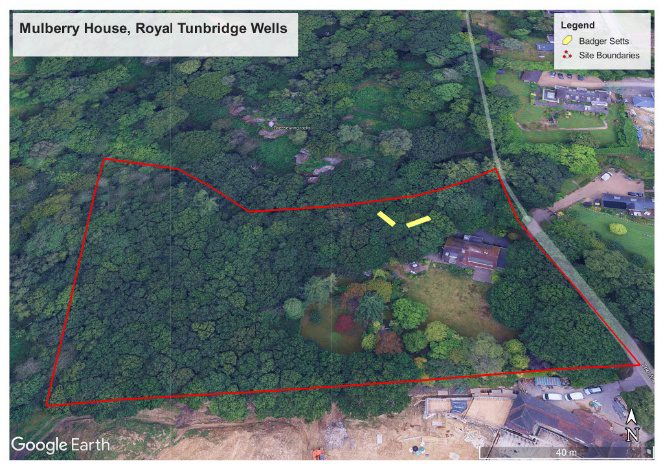
Further challenges arose with the discovery of two active badger setts along the northern site boundary. DDE worked in close partnership with the project team, implementing exclusion zones and adapting site activities to prevent disturbance while allowing the demolition works to progress safely and efficiently.
Site boundaries denoted in red pathway. Approximate location of badger setts denoted in yellow polygons.
Critical Programme Requirements
The demolition works formed a vital enabling package within the wider redevelopment scheme. Completion was required within a strict three-week period to allow the new-build phase to commence on schedule, creating a demanding programme alongside the significant ecological constraints.
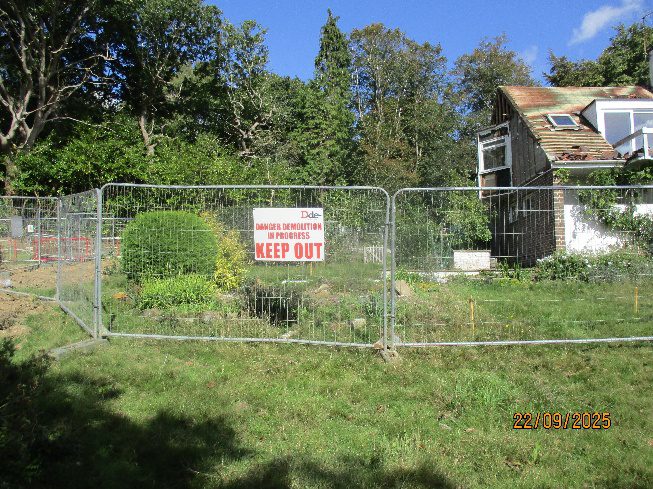
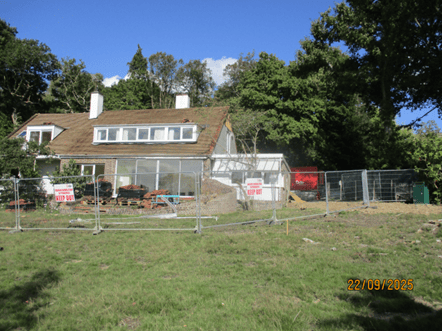
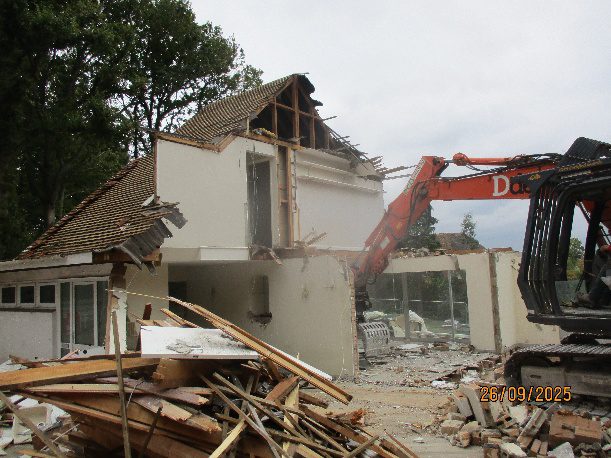
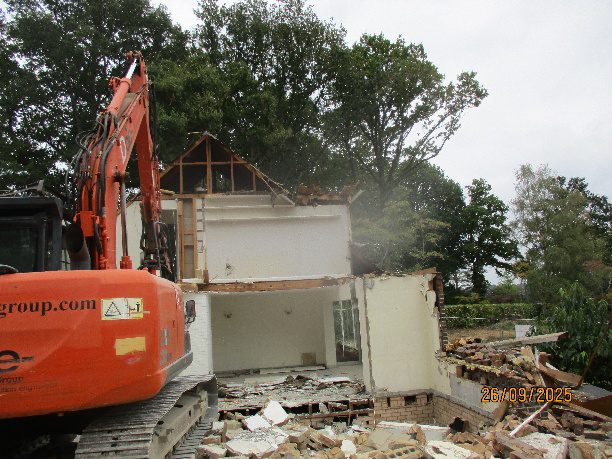
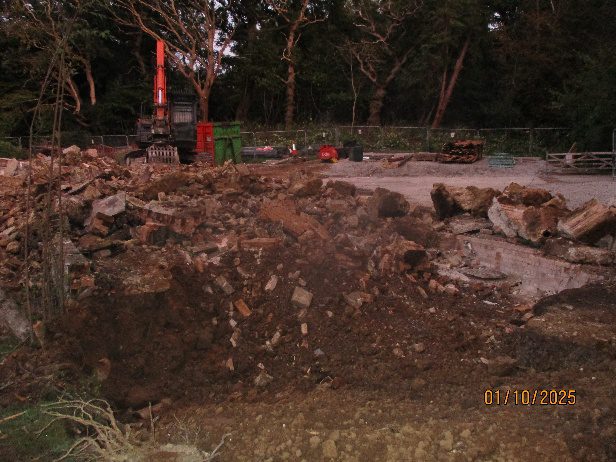
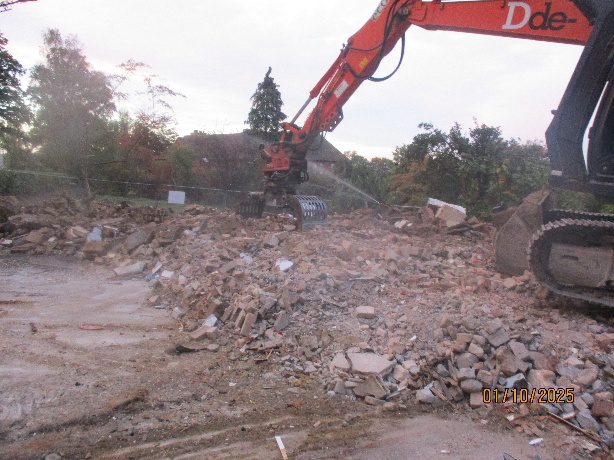
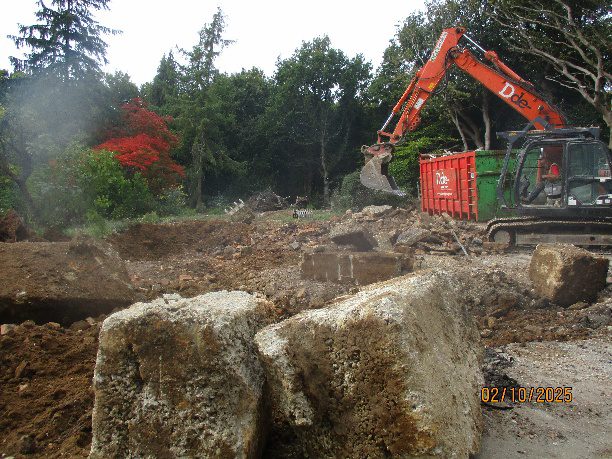
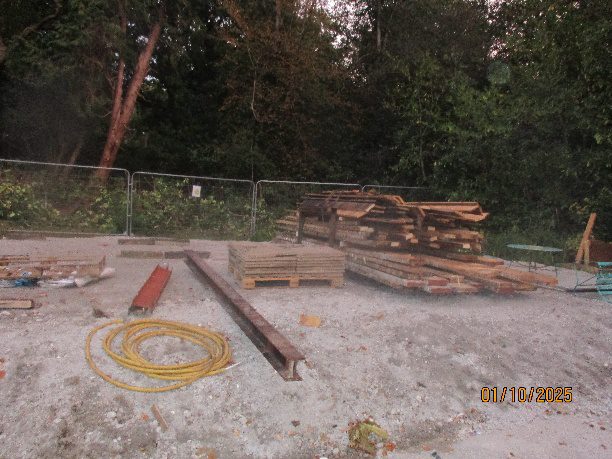
Demolition in progress.
Innovation and Technical Excellence
The project’s success was founded on meticulous pre-planning, collaborative working and a carefully engineered demolition methodology.
DDE developed a sequenced approach that integrated ecological protection measures into every phase of the works. Continuous liaison between demolition operatives, ecologists and client representatives ensured all licence conditions, ecological commitments and planning requirements were fully satisfied without impacting programme delivery.
The project demonstrated how technical excellence, proactive communication and effective environmental management can successfully overcome complex ecological constraints while maintaining operational efficiency.
Environmental Management and Sustainability
Environmental protection was central to the project’s planning and execution.
DDE implemented a comprehensive Construction Environmental Management Plan incorporating:
- Dust suppression and environmental monitoring.
- Noise and vibration controls.
- Air quality management.
- Traffic management procedures.
- Pollution prevention measures.
- Waste minimisation and resource recovery initiatives.
Dust emissions were effectively managed through water mist suppression systems, controlled demolition techniques, damping down of haul routes and ongoing environmental monitoring.
Sustainability performance was equally impressive. The project achieved a recycling and recovery rate exceeding 95%, diverting most demolition materials from landfill through reuse and recycling. Asbestos-containing materials were removed under a specialist contract prior to demolition commencing.
Health, Safety and Wellbeing
Despite the challenging ecological constraints and compressed programme, health, safety and environmental performance remained uncompromised.
Key Safety Achievements
- Zero reportable accidents.
- Zero environmental incidents.
- Zero enforcement notices.
- No health, safety or environmental audit non-conformances.
- Safe completion of all works adjacent to protected habitats and active badger setts.
The project exemplifies DDE’s commitment to creating safe working environments while delivering technically demanding demolition works.
Results and Achievements
Programme Performance
- Completed within the client’s critical three-week programme.
- Redevelopment works commenced on schedule without delay.
Safety Performance
- Zero reportable accidents.
- Zero environmental incidents.
- Zero enforcement notices.
Environmental Performance
- Recycling and recovery rate exceeding 95%.
- Full compliance with ecological, arboricultural and planning requirements.
- Successful protection of active bat roosts, badger setts and surrounding woodland habitats.
- No environmental breaches, regulatory action or ecological incidents.
Client Benefits
- Safe, efficient and compliant demolition delivery.
- Programme certainty maintained despite significant environmental constraints.
- Seamless transition to the redevelopment phase.
Conclusion
The demolition of Mulberry House demonstrates how complex demolition projects can be delivered successfully within highly sensitive ecological environments without compromising safety, sustainability or programme performance.
The project recorded zero reportable accidents, zero environmental incidents, zero enforcement notices and a recycling and recovery rate exceeding 95%, while safeguarding protected species and their habitats throughout the works.


